

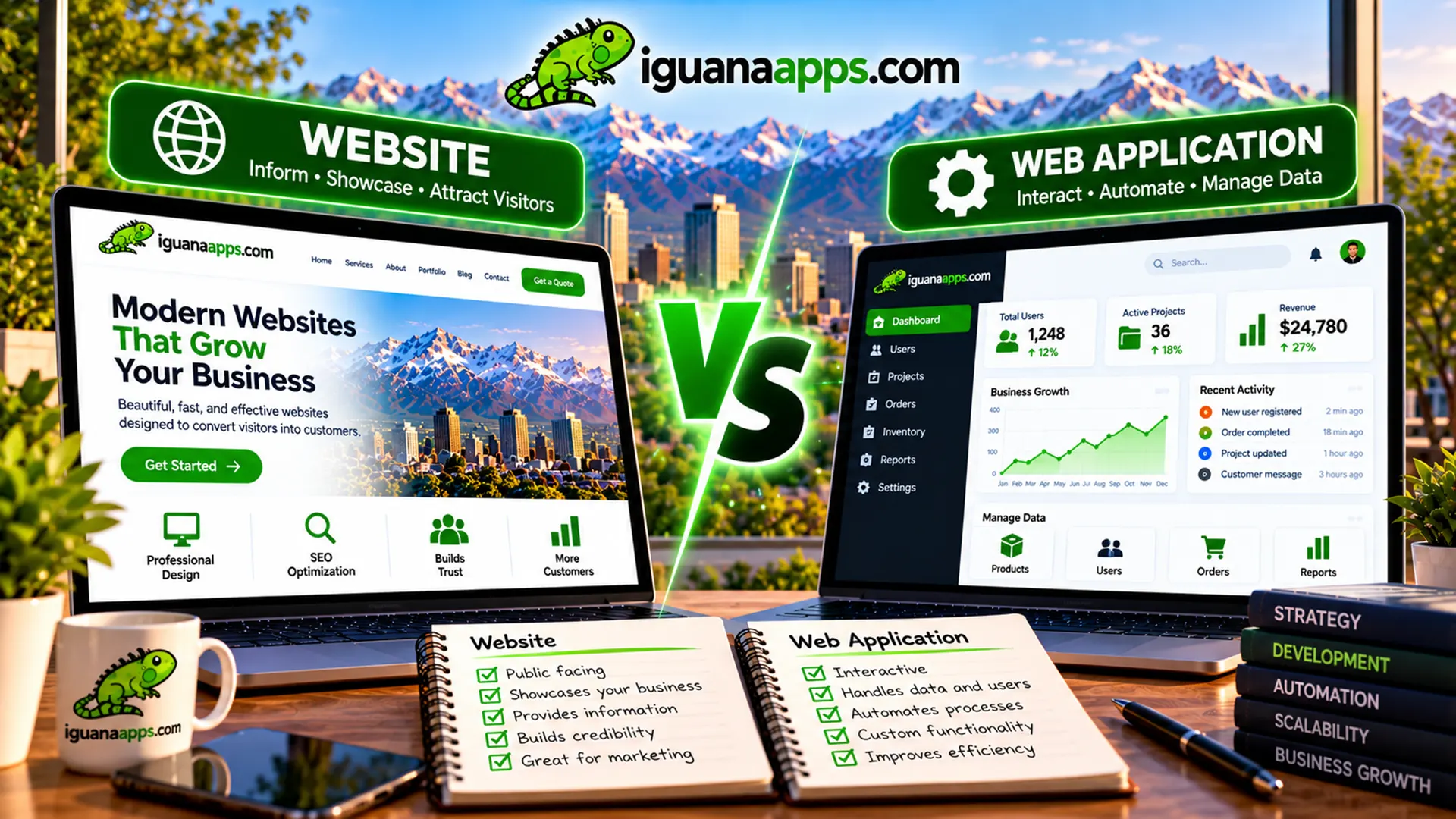
When a business starts thinking about improving its online presence, one of the first questions is whether it needs a traditional website or something more advanced.
While the terms “website” and “web application” are sometimes used interchangeably, they serve different purposes.
Understanding the difference can help you choose the right technology for your business and avoid spending money on a solution that doesn’t meet your needs.
What Is a Website?
A website is primarily designed to provide information to visitors.
For example, a business website might include:
- Information about your company
- Products or services
- About Us page
- Contact information
- Blog or articles
- Frequently asked questions
- Testimonials
- Location and hours
The primary goal is usually to help visitors learn about your business and encourage them to take an action, such as calling, submitting a form, requesting a quote, or making a purchase.
Most small business websites fall into this category.
What Is a Web Application?
A web application is a website that provides interactive functionality and allows users to perform tasks.
Instead of simply reading information, users interact with the application.
Examples include:
- Customer portals
- Online booking systems
- Project management systems
- Employee dashboards
- Inventory systems
- Online calculators
- Membership platforms
- CRM systems
- Scheduling applications
- Online ordering systems
- Business management tools
A web application may look like a website from the outside, but behind the scenes it can contain considerably more functionality.
The Biggest Difference
The easiest way to think about it is this:
A website primarily provides information. A web application allows users to perform tasks.
For example, a landscaping company might have a website explaining its services.
A web application could allow customers to:
- Create an account.
- Request an estimate.
- Select available services.
- Schedule an appointment.
- Make a payment.
- View previous appointments.
- Communicate with the company.
The website communicates with customers. The application helps customers interact with the business.
Can a Website Become a Web Application?
Yes.
Many businesses start with a traditional website and eventually discover that they need additional functionality.
For example, a company might initially have a simple contact form. As the company grows, it may want customers to create accounts and track their orders.
Instead of replacing everything, developers can often expand the existing website or build an application that works alongside it.
When Does a Business Need a Web Application?
A web application may make sense when your business has repetitive processes that are currently handled manually.
Ask yourself:
- Are employees entering the same information repeatedly?
- Are customers constantly calling to ask about order status?
- Are you managing appointments manually?
- Are employees using spreadsheets to manage important business processes?
- Do customers need accounts?
- Do different systems need to communicate with each other?
- Are you copying information between multiple platforms?
- Could software automate a repetitive process?
If you answered yes to several of these questions, a web application could potentially save time and improve the customer experience.
Custom Web Applications Can Solve Unique Problems
Off-the-shelf software is useful for many businesses, but it isn’t always a perfect fit.
Your business may have a process that is unique to your industry or company.
A custom web application can be designed around that process rather than forcing your employees to change the way they work to accommodate generic software.
The result can be a system that matches your actual workflow.
What About Cost?
Generally, a web application requires more development than a basic informational website because it involves additional functionality, databases, user accounts, security, integrations, and business logic.
That doesn’t necessarily mean a web application is the right choice for every business.
The important question is whether the technology provides enough value to justify the investment.
If an application saves your team dozens of hours every month or significantly improves the customer experience, the investment may make sense.
Choosing the Right Solution
You don’t necessarily need to choose between a website and a web application.
Many businesses use both.
A public-facing website can attract visitors, explain the company’s services, and generate leads.
A web application can then provide functionality for customers, employees, or business operations.
Together, they can create a much more complete digital system.
Need Help Deciding What Your Business Needs?
Choosing the right technology starts with understanding the problem you’re trying to solve.
At Iguana Technologies, we help businesses evaluate their website and software needs and develop solutions designed around their goals.
Whether you need a professional business website, an e-commerce platform, or a custom web application, the right technology can make your business easier to operate and easier for customers to use.
Ready to explore what’s possible? Contact us at Iguana Technologies to discuss your project.
Contact us
Get a FREE, NO OBLIGATION consultation appointment any time, by filling out the form below!
