

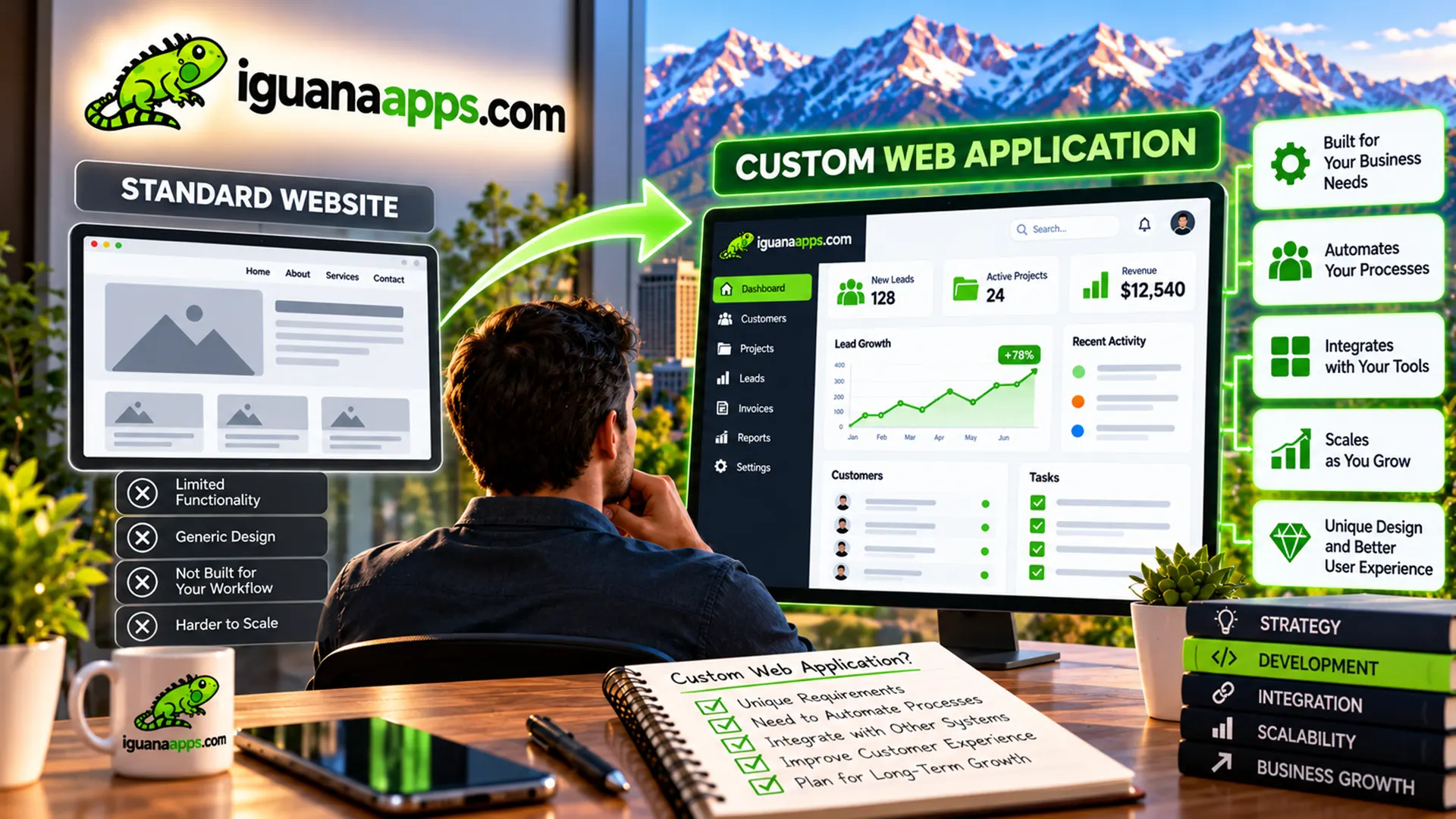
Businesses have more software choices than ever.
There are platforms for accounting, scheduling, customer management, inventory, communication, payments, marketing, and almost every other business function.
So why would a company ever need custom software?
The answer is simple: sometimes existing software doesn’t solve the problem.
A custom web application can be worthwhile when your business has unique requirements that off-the-shelf software can’t handle efficiently.
Start With the Problem
The first question shouldn’t be:
“Do we need custom software?”
Instead, ask:
“What problem are we trying to solve?”
Maybe employees are spending hours every week performing repetitive tasks.
Maybe customers don’t have a convenient way to access information.
Maybe several systems don’t communicate with each other.
Maybe your business has a unique workflow that generic software doesn’t support.
Understanding the problem comes first.
Sign #1: You’re Using Too Many Spreadsheets
Spreadsheets can be incredibly useful.
But when a business begins using dozens of spreadsheets to manage customers, inventory, scheduling, projects, or other operations, things can become difficult to maintain.
A custom application can potentially replace some of these manual processes with a centralized system.
Sign #2: Employees Perform Repetitive Tasks
Look for tasks that happen repeatedly.
For example:
- Copying customer information
- Creating the same reports
- Sending repetitive notifications
- Updating multiple systems
- Moving information between spreadsheets
- Manually processing requests
If employees repeatedly perform the same steps, automation may be possible.
Sign #3: Your Existing Software Doesn’t Fit
Sometimes businesses use software that is close to what they need—but not quite.
Employees may have developed workarounds to compensate.
Those workarounds can create additional complexity.
If your team constantly says things like:
“The software doesn’t let us do that.”
or
“We have to do this manually.”
it may be worth investigating whether custom development could solve the problem.
Sign #4: Customers Need Better Online Access
Customers increasingly expect convenient digital experiences.
Depending on your business, they may want to:
- Check orders
- Schedule appointments
- Submit requests
- View documents
- Make payments
- Manage accounts
- Track projects
- Communicate with employees
A custom customer portal can provide functionality specifically designed around your customer journey.
Sign #5: Multiple Systems Need to Communicate
Your business may already use several software platforms.
For example:
Website → CRM → Accounting → Payment Processing
If these systems don’t communicate effectively, employees may have to transfer information manually.
Custom integrations or an application layer can help connect those systems.
Sign #6: Your Business Has a Unique Workflow
Every business has processes.
Some are simple.
Others are highly specialized.
If your company’s workflow is significantly different from the standard workflow assumed by commercial software, custom development may provide a better fit.
The software can be designed around your process rather than requiring your process to change.
Sign #7: Your Business Is Growing
Growth can expose weaknesses in existing processes.
A workflow that works for 20 customers may become difficult to manage with 2,000.
As volume increases, automation and centralized information become increasingly valuable.
Building the right system before growth creates operational problems can help a company prepare for increased demand.
Custom Doesn’t Always Mean Starting From Scratch
Custom development doesn’t necessarily mean replacing everything.
Sometimes the best solution is to improve your existing website.
Other times, it may involve adding a customer portal, connecting two systems, or building a small application that handles one specific process.
A professional developer can help determine what level of customization makes sense.
Consider the Return on Investment
Custom software requires an investment.
Before starting development, consider what the system could save or improve.
For example:
- How many employee hours could it save?
- Could it reduce repetitive data entry?
- Could it increase customer satisfaction?
- Could it help your business handle more customers?
- Could it reduce operational mistakes?
- Could it generate additional revenue?
- Could it eliminate several separate software subscriptions?
The goal isn’t simply to build technology.
The goal is to create business value.
When Custom Development May Not Be Necessary
Custom software isn’t automatically the right answer.
If an existing platform already solves your problem effectively, purchasing or subscribing to that platform may be more practical.
Custom development makes the most sense when the benefits of a tailored solution justify the additional development and maintenance requirements.
Start With a Technology Assessment
If you’re unsure whether custom development makes sense, start by documenting your current processes.
Identify:
- What your employees do.
- What your customers do.
- Which systems you currently use.
- Where information is stored.
- Where repetitive work occurs.
- Where bottlenecks occur.
- What you’d like to improve.
This gives a developer a much clearer picture of the opportunity.
Build Only What You Need
A successful custom application doesn’t have to contain hundreds of features.
In many cases, starting with the most important functionality is better.
Build the core system, use it, gather feedback, and expand as the business needs evolve.
At Iguana Technologies, we help businesses turn operational challenges into practical web applications and integrations.
If your team is spending too much time working around existing software, let’s discuss whether a custom solution could make your business more efficient.
Contact us at Iguana Technologies to start a conversation about your project.
Contact us
Get a FREE, NO OBLIGATION consultation appointment any time, by filling out the form below!
