

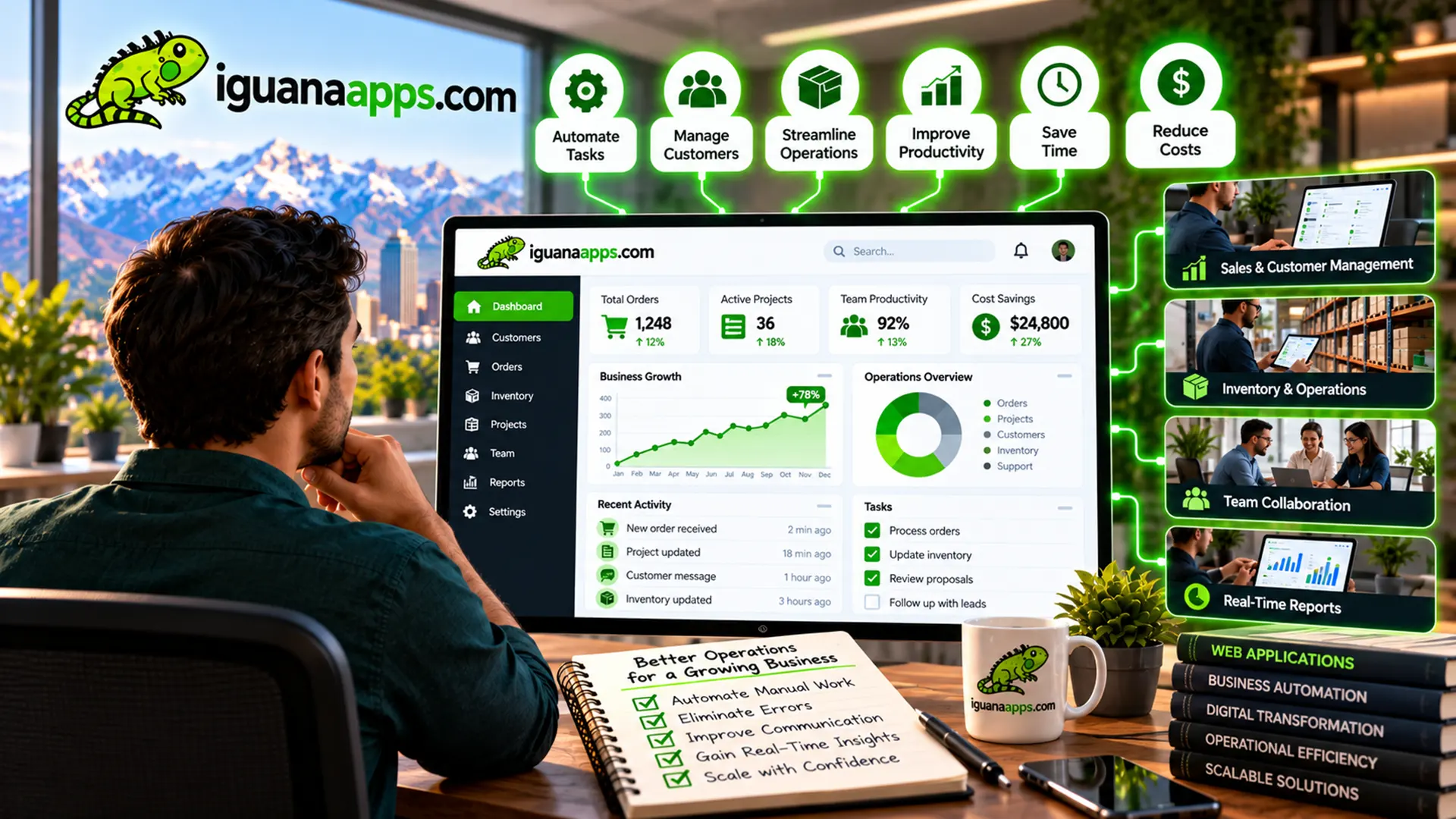
Running a business often involves dozens of repetitive processes.
Employees enter information, update spreadsheets, send emails, schedule appointments, generate reports, process orders, and communicate with customers.
Over time, these processes can become inefficient.
A custom web application can help businesses automate and organize many of these tasks.
Instead of forcing your business to adapt to generic software, custom software can be designed around the way your company actually operates.
What Is a Custom Web Application?
A custom web application is software built specifically for a particular business or business process.
Unlike a standard website, it can perform tasks and manage information.
For example, a company could build an application for:
- Scheduling
- Customer management
- Inventory
- Estimates
- Invoicing
- Employee management
- Reporting
- Order processing
- Customer portals
- Internal workflows
The application can be accessible through a web browser, allowing employees or customers to use it from computers, tablets, or phones.
Automate Repetitive Tasks
One of the biggest benefits of custom software is automation.
Consider a business where employees receive requests through email.
An employee reads each request, enters the information into a spreadsheet, creates a customer record, and sends a confirmation.
A custom application could potentially automate much of that workflow.
The customer submits a request.
The system records it.
The appropriate employee is notified.
The customer receives confirmation.
Information is stored in one central location.
Automation doesn’t replace the need for people. Instead, it can allow employees to spend less time on repetitive administrative work.
Centralize Information
Many businesses rely on multiple spreadsheets and software systems.
Information may be scattered across:
- Spreadsheets
- Accounting software
- CRM systems
- Paper documents
- Shared drives
- Separate databases
A custom application can provide a centralized interface for important business information.
Employees can have a single place to access the information they need.
Improve Customer Service
Custom applications aren’t only useful internally.
They can improve the customer experience as well.
For example, a customer portal could allow customers to:
- View their account
- Submit requests
- Check order status
- Schedule appointments
- Download documents
- Make payments
- Update information
- Communicate with your team
Giving customers access to useful information can reduce the need for them to call or email your staff for routine questions.
Create Better Workflows
Generic software often requires businesses to adapt their processes.
Custom applications work in the opposite direction.
The software can be designed around your workflow.
For example, imagine a company with a five-step approval process.
A custom application could guide employees through each step, record who approved each stage, and notify the next person automatically.
Instead of relying on emails and spreadsheets, the workflow becomes part of the software.
Reduce Human Error
Whenever people repeatedly copy information between systems, mistakes can happen.
Automation can reduce unnecessary manual data entry.
For example, when a customer submits information through a website, that information could automatically be added to the appropriate database.
Employees don’t need to retype the information.
The fewer unnecessary manual steps in a process, the fewer opportunities there are for simple data-entry errors.
Improve Business Visibility
A custom application can also make it easier to understand what’s happening in your business.
Depending on the system, managers could have access to dashboards showing information such as:
- New customers
- Open orders
- Pending requests
- Sales activity
- Appointments
- Employee workload
- Inventory
- Revenue-related information
Instead of manually compiling reports, information can be presented in one place.
Integrate Your Existing Software
Custom software doesn’t necessarily mean replacing everything you already use.
A custom application can often communicate with existing systems through APIs and other integrations.
For example, your application might connect to:
- Payment systems
- Accounting platforms
- CRM software
- Email services
- Scheduling platforms
- Inventory systems
This allows businesses to build new functionality while continuing to use systems they already depend on.
Custom Software Should Solve a Real Problem
Building custom software simply because it’s possible isn’t a good reason to do it.
The best projects begin with a specific business problem.
Ask:
What takes too much time?
What process is unnecessarily complicated?
Where are employees repeatedly entering information?
What do customers constantly ask about?
What information is difficult to access?
These questions can reveal opportunities for automation and improvement.
Is Custom Software Right for Your Business?
A custom web application may make sense when:
- Your business has unique workflows.
- Existing software doesn’t meet your needs.
- Employees spend significant time on repetitive tasks.
- Multiple systems need to communicate.
- Customers need an online portal.
- You need specialized functionality.
- Your current process relies heavily on spreadsheets.
The goal should always be to solve a measurable business problem.
Build Technology Around Your Business
Your software should support the way your business works.
At Iguana Technologies, we build custom websites, web applications, integrations, and digital solutions designed around real business requirements.
Instead of forcing your company into a one-size-fits-all system, we can help identify opportunities to simplify workflows and create technology that fits your organization.
If your business is spending too much time working around its software, contact us at Iguana Technologies to explore a custom solution.
Contact us
Get a FREE, NO OBLIGATION consultation appointment any time, by filling out the form below!
