

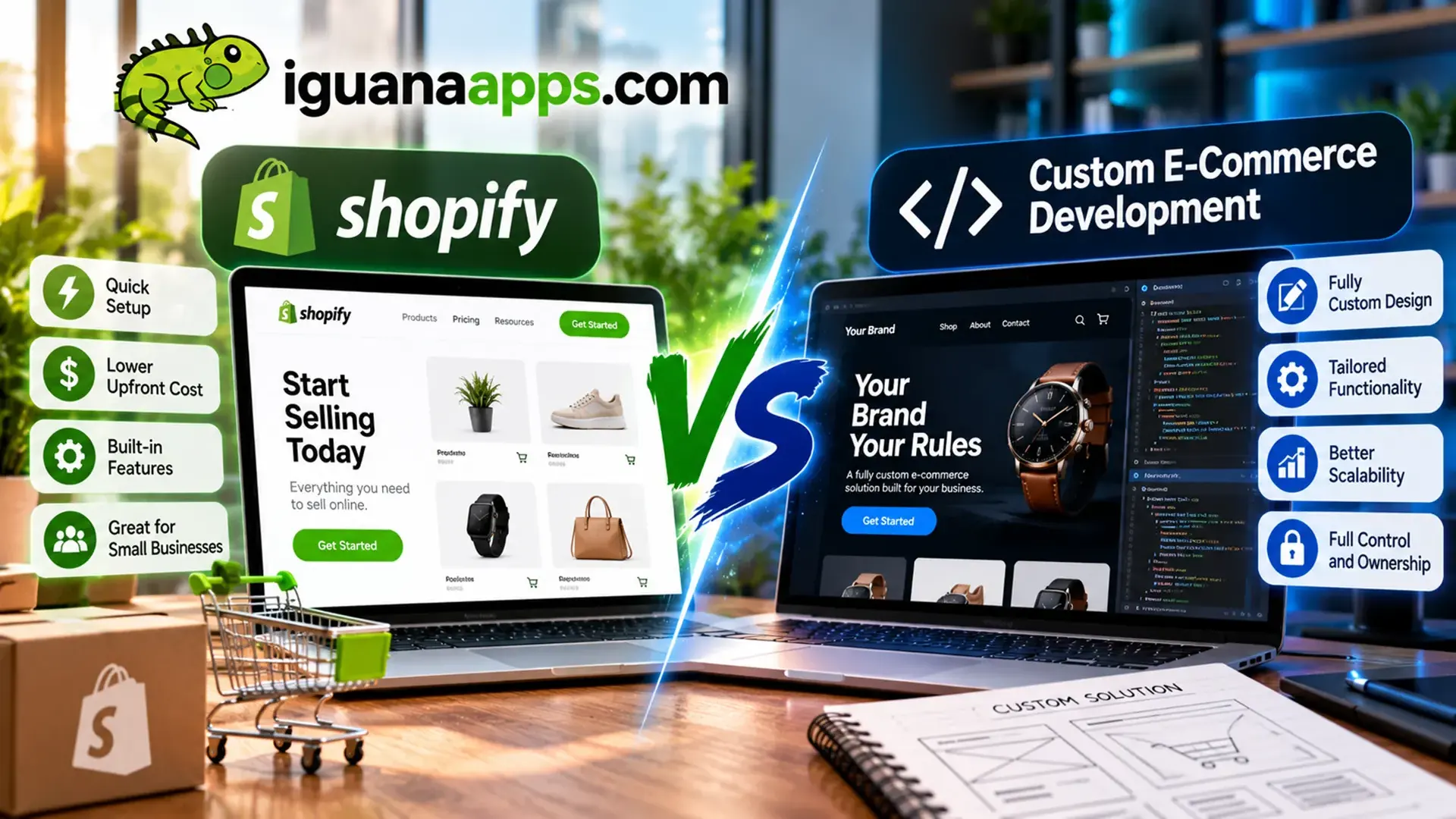
If you’re planning an online store, one of the biggest decisions you’ll make is choosing how the store will be built.
Should you use an established e-commerce platform such as Shopify?
Or should you invest in a custom e-commerce solution?
Both approaches can work.
The right choice depends on your products, business processes, budget, technical requirements, and long-term goals.
What Is Shopify?
Shopify is a hosted e-commerce platform that provides many of the tools businesses need to sell products online.
It can provide functionality for:
- Product management
- Shopping carts
- Checkout
- Payments
- Order management
- Store themes
- Apps and integrations
One of its major advantages is that businesses can get an online store running without building the entire underlying platform themselves.
What Is Custom E-Commerce Development?
Custom e-commerce development involves building a website or application around the specific requirements of a business.
Instead of adapting the business to an existing platform, developers can design the technology around the business’s processes.
Custom development can be useful when a company has specialized requirements that standard platforms don’t handle efficiently.
Shopify Advantages
Faster Launch
A hosted platform can reduce the amount of infrastructure that needs to be built from scratch.
Established E-Commerce Features
Businesses can access many common e-commerce capabilities without developing every component themselves.
Easier Management
Depending on the configuration, business owners and employees can manage products and orders through an established administrative interface.
App Ecosystem
Third-party applications can add functionality to a store.
Shopify Considerations
There are also trade-offs.
Your business may encounter limitations involving:
- Custom workflows
- Specialized integrations
- Platform-specific functionality
- Ongoing subscription costs
- Dependence on third-party applications
Whether these limitations matter depends on your business.
Custom E-Commerce Advantages
Maximum Flexibility
Custom development can allow a business to build functionality around its specific requirements.
Custom Integrations
If your company relies on specialized internal systems, custom development can provide more control over how those systems interact.
Unique Customer Experiences
A custom solution can provide shopping experiences that aren’t easily achieved with a standard theme or application.
Business-Specific Workflows
If your business has unusual pricing, ordering, quoting, fulfillment, or account requirements, custom development may be worth considering.
Custom E-Commerce Considerations
Custom development generally requires more planning and development work.
You may also need to consider:
- Development costs
- Ongoing maintenance
- Hosting
- Security
- Updates
- Technical support
Custom software provides flexibility, but that flexibility comes with responsibility.
Which One Is Better?
There isn’t a universal answer.
A small business with a straightforward product catalog may be perfectly well served by a hosted e-commerce platform.
A company with complex pricing, inventory systems, customer portals, or specialized workflows may need a custom solution.
The right question isn’t:
“Which platform is best?”
The better question is:
“Which solution fits our business requirements?”
Consider Your Business Requirements
Before choosing, make a list of everything your store needs.
For example:
Products
How many products will you sell?
Do products have complex variations?
Customers
Do customers need accounts?
Do you offer wholesale pricing?
Payments
Which payment methods do you need?
Shipping
Are shipping rules straightforward or highly customized?
Inventory
Do you already have an inventory management system?
Integrations
Does your website need to communicate with other software?
Growth
Will your requirements change significantly as the business grows?
Answering these questions can make the technology decision much easier.
Don’t Choose Technology Before Defining the Problem
One of the most common mistakes businesses make is choosing a platform first and figuring out requirements afterward.
Instead, start with the business.
Understand the customer experience.
Document the workflows.
Identify integrations.
Then determine which technology makes the most sense.
Sometimes the Answer Is a Combination
The decision doesn’t always have to be strictly “platform versus custom.”
Some businesses can use an established platform for standard e-commerce functionality while adding custom integrations or applications where needed.
The best architecture depends on the specific project.
Need Help Choosing an E-Commerce Platform?
Iguana Technologies can help you evaluate your requirements before you commit to a particular e-commerce technology.
We’ll look at your products, customers, workflows, integrations, and goals to help determine what type of solution makes sense for your business.
Contact us at Iguana Technologies to discuss your e-commerce project.
Contact us
Get a FREE, NO OBLIGATION consultation appointment any time, by filling out the form below!
