

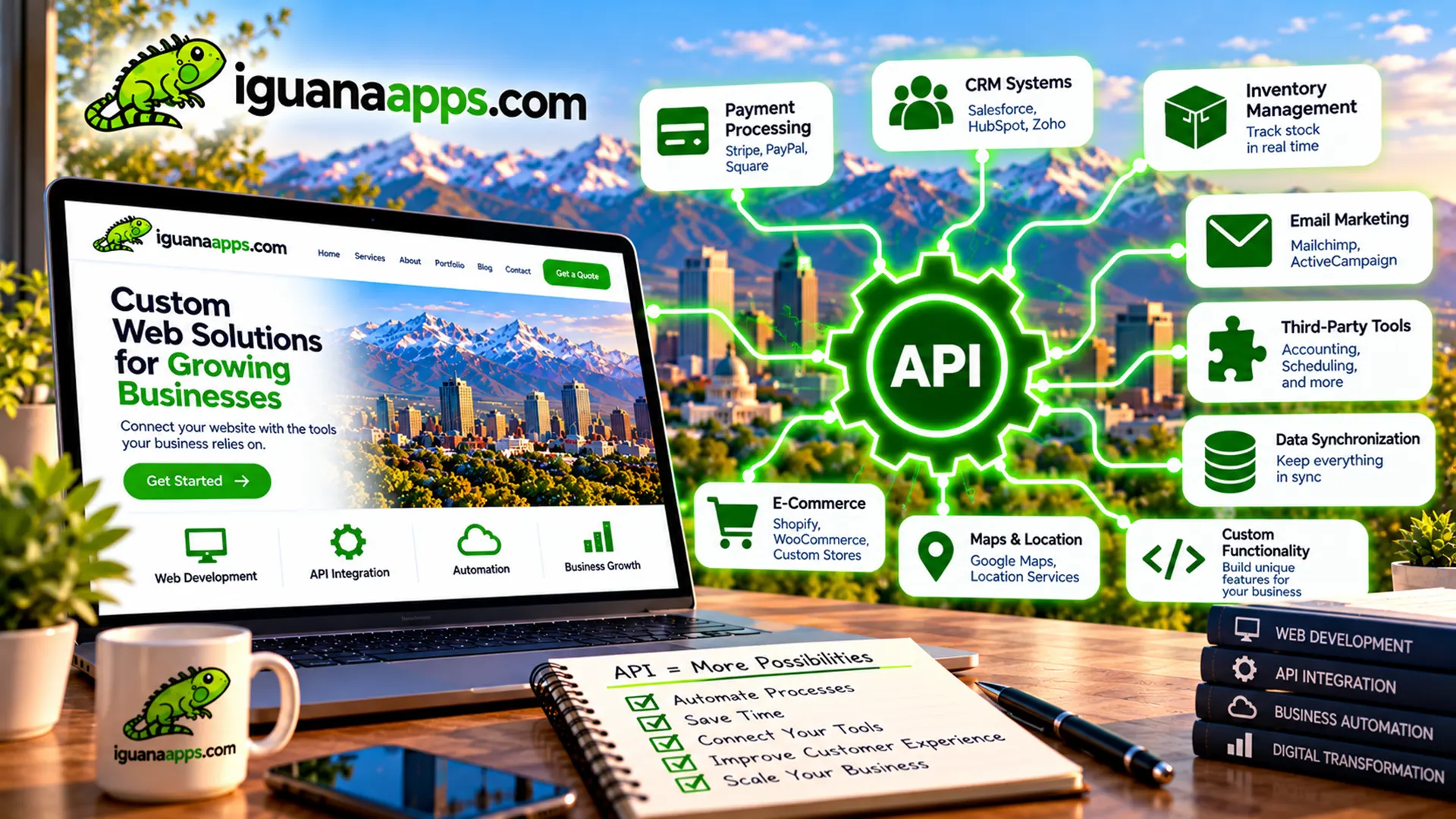
The modern business website rarely operates by itself.
Your website may need to communicate with payment processors, accounting software, customer databases, email platforms, scheduling systems, inventory systems, mobile apps, or other services.
This is where APIs come in.
If you’ve heard developers talk about APIs but aren’t sure what they actually do, don’t worry. The concept is easier to understand than it sounds.
What Is an API?
API stands for Application Programming Interface.
An API allows different software systems to communicate with each other.
Think of an API as a messenger between two systems.
For example, imagine your website needs to display information stored in another system.
Instead of manually copying the information every day, your website can use an API to request the information automatically.
The other system sends the requested information back, and your website can use it.
A Simple Example
Imagine you own an online store.
Your website needs to know whether a product is in stock.
Your inventory system contains that information.
An API can allow your website to communicate with the inventory system.
When a customer views a product, the website can request the current inventory information.
The customer might then see:
In Stock
or
Currently Unavailable
The systems are communicating automatically.
APIs Connect Business Systems
APIs can connect many different types of software.
For example:
Website → Payment Processor
Allows customers to make payments online.
Website → CRM
Sends new customer information to your sales system.
Website → Accounting Software
Transfers relevant transaction information.
Website → Scheduling System
Displays available appointments.
Website → Inventory System
Displays product availability.
Website → Mobile App
Allows a mobile application and website to use the same underlying data.
This connectivity can eliminate a significant amount of manual work.
Why APIs Matter to Small Businesses
APIs aren’t just for large technology companies.
Small businesses can benefit from them as well.
Suppose your business uses five different software systems.
Without integration, employees may have to enter the same information into multiple platforms.
With the right integrations, information can potentially move automatically between systems.
That can reduce repetitive work and make processes more consistent.
APIs Can Improve Customer Experiences
Customers expect businesses to provide convenient digital experiences.
For example, customers may want to:
- Schedule appointments online
- Receive order updates
- Pay online
- Create accounts
- Track purchases
- Request quotes
- Check availability
- Receive automated notifications
Many of these experiences require multiple systems to work together.
APIs make that communication possible.
APIs and Custom Web Applications
APIs become particularly valuable when building custom web applications.
A custom application may need to connect with existing business systems rather than operate independently.
For example, a custom customer portal might connect to your CRM, payment processor, inventory database, and email system.
The result can be a centralized experience for your customers while your existing business systems continue working behind the scenes.
APIs Can Reduce Manual Data Entry
Manual data entry creates opportunities for mistakes.
If an employee has to enter the same customer information into three different systems, there are three opportunities for something to be entered incorrectly.
Automation through APIs can reduce unnecessary duplication.
Instead of entering information repeatedly, a system can transfer it automatically when appropriate.
Security Still Matters
APIs need to be designed and secured properly.
A poorly designed integration can create security or reliability problems.
Professional development should consider:
- Authentication
- Authorization
- Data validation
- Encryption
- Rate limiting
- Error handling
- Logging
- Access controls
The goal isn’t simply to connect two systems. The connection needs to be designed responsibly.
Does Your Business Need an API?
You may benefit from API integration if your business uses multiple systems that need to share information.
Some signs include:
- Employees repeatedly copy information between systems.
- Your website needs information from another platform.
- Customers need real-time information.
- You want to automate repetitive processes.
- You’re developing a mobile app.
- You need a customer portal.
- Your business relies on multiple software platforms.
Build a More Connected Business
Your website doesn’t have to operate as an isolated system.
With the right integrations, your website can become a central part of your business technology ecosystem.
At Iguana Technologies, we help businesses connect websites, applications, databases, and third-party services to create more efficient digital systems.
If you’re spending too much time moving information between platforms, it may be time to explore automation and integration.
Contact us at Iguana Technologies to discuss how custom web development and API integrations can improve your business.
Contact us
Get a FREE, NO OBLIGATION consultation appointment any time, by filling out the form below!
