

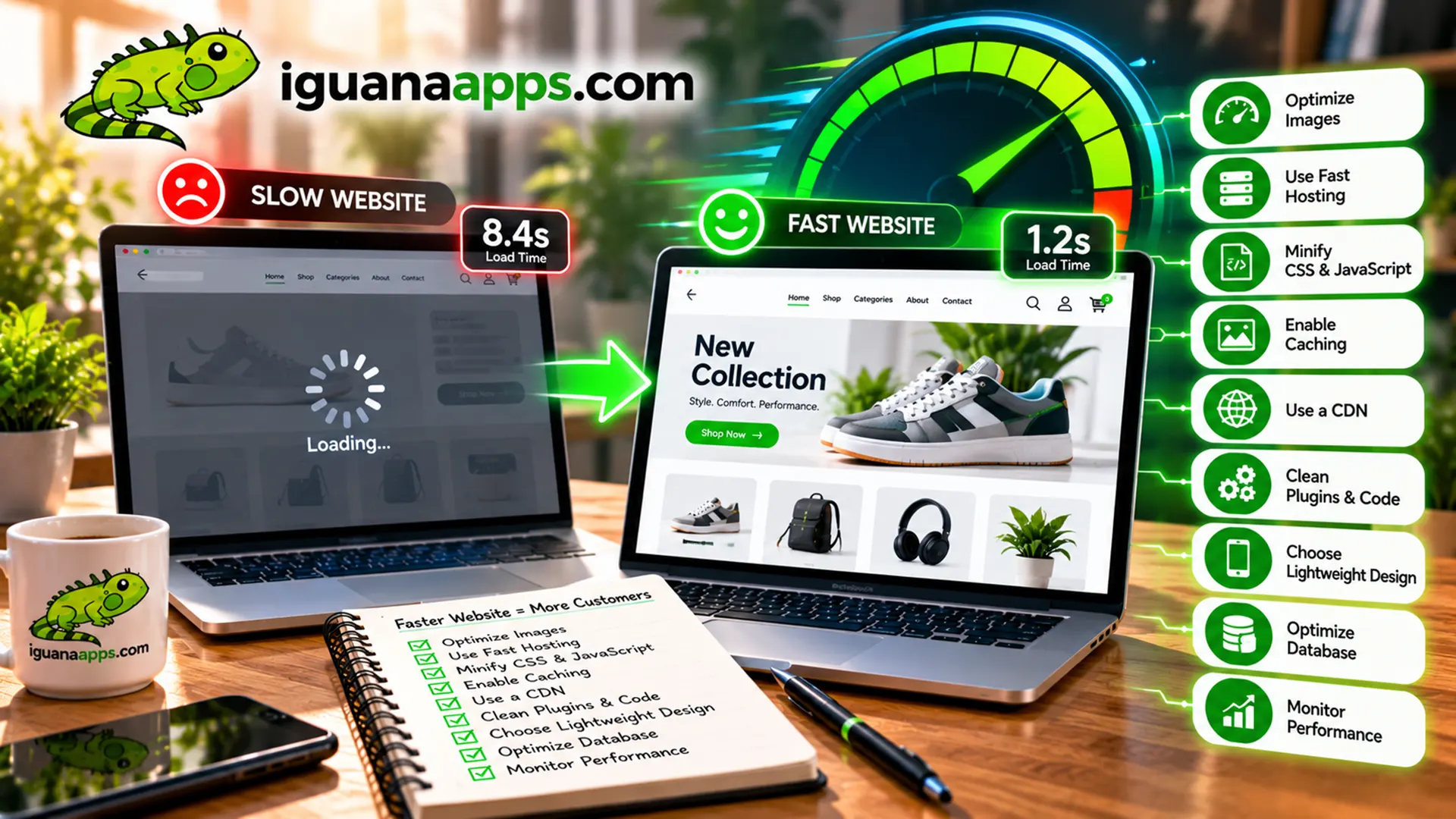
Nobody likes waiting for a website to load.
A visitor may be interested in your business, product, or service, but a slow website can create frustration before they even see your content.
Website performance depends on many factors, including hosting, images, code, plugins, scripts, databases, and third-party services.
Fortunately, there are several ways businesses can improve website speed.
Here are ten areas worth reviewing.
- Optimize Your Images
Large image files are one of the most common causes of slow websites.
Before uploading an image, make sure it is:
- The appropriate dimensions
- Properly compressed
- Saved in an appropriate format
- Optimized for the web
There’s rarely a reason to upload a massive image when the website only displays a small version.
- Use Modern Image Formats
Modern image formats can often provide good visual quality while keeping file sizes smaller.
Your developer can determine which formats and delivery methods make sense for your website.
The important thing is to avoid unnecessarily large image files.
- Use Browser Caching
Caching allows certain website resources to be stored temporarily so returning visitors don’t have to download everything again.
Proper caching can reduce the amount of work required each time someone visits a page.
- Reduce Unnecessary Scripts
Third-party scripts can provide useful functionality.
Analytics, chat tools, advertising systems, social media widgets, and other services can all add features to a website.
But every additional script can potentially affect performance.
Review your website regularly and remove services you no longer need.
- Optimize Your Code
Poorly structured or inefficient code can make a website slower.
Developers can review:
- CSS
- JavaScript
- HTML
- Database queries
- Server-side processes
Optimization can reduce unnecessary work and improve page performance.
- Choose Appropriate Hosting
Your website’s hosting environment matters.
A very small website may have different hosting requirements than an online store or custom web application.
If your website has grown significantly, it may be worth reviewing whether your current hosting solution is still appropriate.
- Use Content Delivery Networks When Appropriate
A content delivery network, or CDN, can help distribute certain website resources through servers located in different geographic regions.
This can improve delivery times for some websites.
Whether a CDN is worthwhile depends on the website and its audience.
- Lazy-Load Certain Content
Not every image needs to load immediately.
For example, images farther down a long page may not need to load until the visitor approaches them.
Lazy loading can reduce the amount of content the browser needs to load immediately.
- Keep Your Website Software Updated
Outdated plugins, frameworks, themes, and other components can create performance and security problems.
Regular maintenance helps keep your website’s technology current.
This is especially important for websites that rely on multiple third-party components.
- Monitor Performance Regularly
Website performance isn’t something you should check once and forget.
Your website changes over time.
New images, plugins, scripts, pages, and features can gradually affect performance.
Regular testing helps identify problems before they become major issues.
Don’t Optimize for Speed at the Expense of Your Customers
Website speed is important, but removing useful functionality simply to make a website smaller isn’t always the right answer.
The goal should be balance.
A good website should be:
- Fast
- Useful
- Attractive
- Accessible
- Functional
- Easy to navigate
Performance improvements should support the overall customer experience.
Start With the Biggest Issues
You don’t necessarily need to rebuild your entire website to improve performance.
Start by identifying the biggest bottlenecks.
For example, you may discover that your website has:
- Oversized images
- Too many scripts
- Slow database queries
- Poor hosting
- Unoptimized code
- Excessive plugins
Fixing the biggest problems first can provide meaningful improvements.
Need Help Improving Website Performance?
Iguana Technologies can evaluate your website’s performance and identify opportunities for improvement.
Whether you need optimization, maintenance, or a complete rebuild, we can help create a faster and more efficient website.
Contact us at Iguana Technologies to discuss your website performance goals.
Contact us
Get a FREE, NO OBLIGATION consultation appointment any time, by filling out the form below!
