

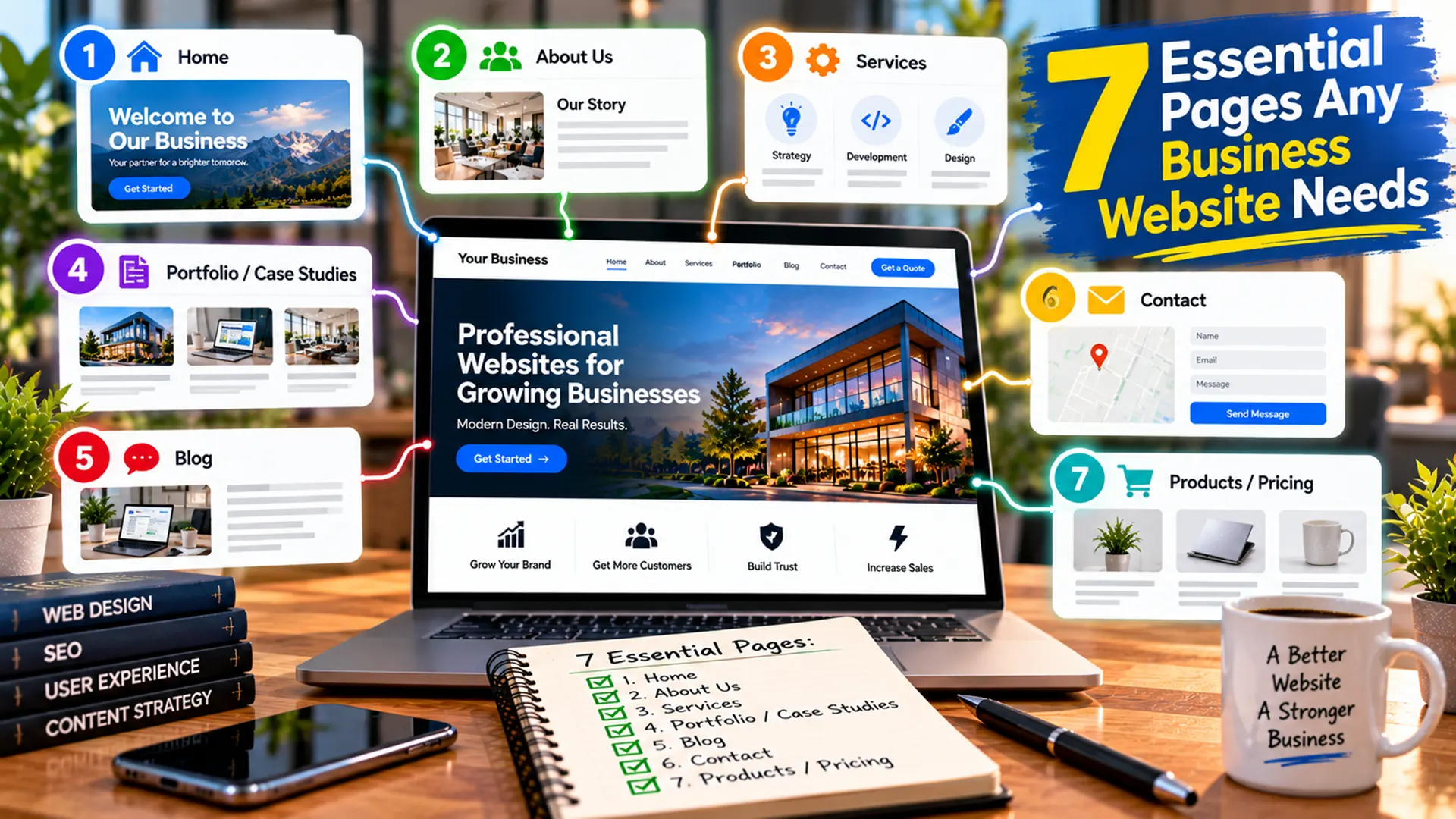
One of the first questions businesses face when creating a website is:
“What pages do we actually need?”
The answer depends on the type of business, but most professional business websites need several core pages that help customers understand the company, evaluate its services, and take action.
Here are seven pages to consider.
- Homepage
Your homepage provides the first impression for many visitors.
It should quickly explain:
- What your business does
- Who you serve
- What you offer
- Why customers should consider you
- What visitors should do next
Your homepage doesn’t need to contain everything.
Its job is to guide visitors toward the information they need.
- About Page
The About page gives visitors an opportunity to learn about your company.
You might include:
- Company history
- Mission
- Team
- Experience
- Values
- Approach
An effective About page should build familiarity and trust.
- Services Page
Your Services page should clearly explain what you offer.
If you provide several major services, consider creating separate pages for each one.
For example, a web development company might have:
- Website Development
- E-Commerce Development
- Web Applications
- Website Redesign
- Website Maintenance
Individual service pages can provide more detailed information and can also support SEO.
- Portfolio or Case Studies
Potential customers often want to see what you’ve done before.
A portfolio can showcase:
- Completed projects
- Designs
- Features
- Industries served
- Results
- Customer testimonials
For professional service businesses, case studies can be particularly useful because they explain not only what was built but also the problem that was solved.
- Contact Page
Your Contact page should make it easy for visitors to reach you.
Consider including:
- Contact form
- Phone number
- Address
- Business hours
- Map
- Social media links where appropriate
Keep the form simple enough that people will actually complete it.
- FAQ Page
Frequently asked questions can reduce uncertainty.
Questions might involve:
- Pricing
- Process
- Timelines
- Services
- Shipping
- Returns
- Scheduling
- Support
An FAQ page can also reduce repetitive customer questions.
- Blog or Resources
A blog can help your business publish useful information that answers customer questions.
For example, a web development company might publish articles about:
- Website development
- SEO
- Website security
- E-commerce
- Website redesign
- Technology
- Online marketing
Useful content can help establish expertise and provide additional opportunities for people to discover your website through search engines.
What About Legal Pages?
Depending on your business and location, your website may also need pages or documents such as:
- Privacy Policy
- Terms and Conditions
- Accessibility information
- Cookie disclosures
- Refund or return policies
The appropriate requirements depend on your business, website, jurisdiction, and the information you collect.
Do You Need Every Page?
Not necessarily.
A small local business may only need five or six pages.
An e-commerce store may require many more.
A large company might need dozens or hundreds of pages.
The goal isn’t to create pages simply to increase the page count.
Every page should have a purpose.
Create Pages Around Customer Questions
A useful way to plan your website is to ask:
What information does someone need before they feel comfortable contacting or buying from us?
Build your website around those questions.
Need Help Planning Your Website?
At Iguana Technologies, we can help businesses determine what pages, functionality, and structure make sense for their goals.
Contact us to discuss your website requirements and create a plan for your project.
The right website structure makes it easier for customers to find information—and easier for them to take the next step.
Contact us
Get a FREE, NO OBLIGATION consultation appointment any time, by filling out the form below!
